Rios Adobe
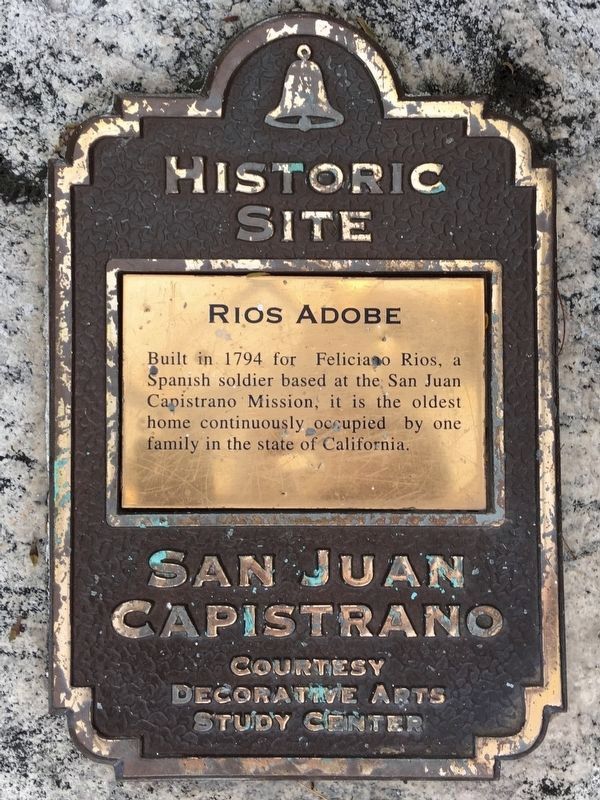
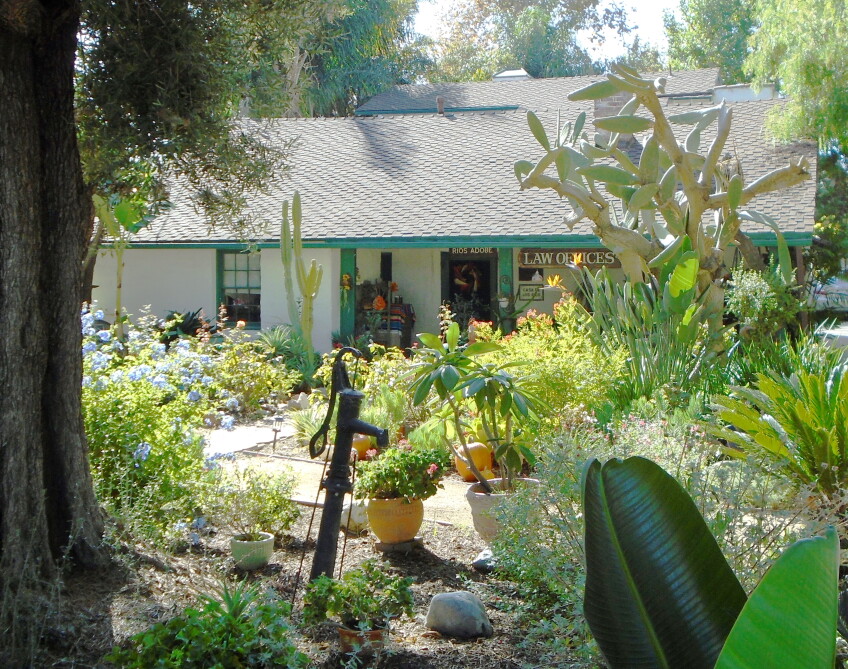
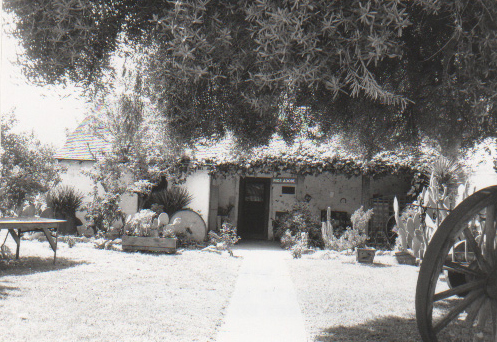
The Rios Adobe is the oldest continuously occupied residence in California and is located on Los Rios Street. Los Rios Street was named for this family. It has been occupied by the descendents of the original family for over 200 years. Feliciano Rios came to San Juan Capistrano with Father Junipero Serra in 1776. He served as a soldier at the Mission for at least ten years before his retirement. Rios married Maria Catalina Garcia de Romero of Mission San Gabriel in 1793 and was given permission by the Mission in 1794 to build a home. This was one of the twenty adobes built along Los Rios Street.
In 1843 Santiago Rios, third son of Feliciano was given a Mexican land grant of 7.7 acres within the original grant (300 varas square) on which the house still stands. He received this grant from Mexican Governor Manual Micheltorena. This is the smallest Mexican land grant recorded. Mexican land grants conveyed title to the land. During the 19th century the building passed down through the family to male descendents. These men and their wives are a significant part of the history of San Juan Capistrano.
Gregorio Rios, grandson of Santiago, is supposed to have sheltered the notorious bandito, Joaquin Murietta, in the attic of the house in the 1850s and may have provided horses as well. In the living room above a display case is a trap door that leads to an attic room where Murrieta was thought to have rested between raids on the ranchos.
A renowned horse trainer, Damian Cosmos Rios, son of Gregorio, often had individuals from England and the East Coast buying their polo ponies from him. In 1927 Gertrude Riena Rios, his wife, opened a restaurant, Casa de Los Rios, at the adobe. During the Depression period the restaurant provided additional income for the family which had nine children.
Daniel J. Rios, Damian and Gertrude’s son, landed on Normandy Beach in World War II. Daniel was later the head of the Homicide and Robbery details of the Orange County Sheriff’s Department. He was well-known for his barbecuing and salsa-making abilities. Many a barbecue was held at the Rios Adobe.
Juanita Rios Foy, sister of Daniel, was born in the Rios Adobe and was the Matriarch of the City from 1986 to 1991. She was active in the Juaneno Indian Council.
The current owner of the adobe is Stephen Rios. Stephen is a former Marine and was Executive Secretary to Governor E. G. Brown, Jr. He was a member of the Native American Heritage Commission and worked to ensure burial sites would not be excavated. He is raising the 10th generation in this adobe.
The Rios Adobe was originally two rooms much like the Montanez Adobe and has been added on and changed over the years, depending upon the generation that as living n the home at the time. In 1998 a two-story addition to the rear of the adobe was added but did not change the adobe itself.
The Rios Adobe is a Private residence. Please respect the families privacy and view from the street only.
Construction of Mission San Juan Capistano, “Jewel of the Missions”, began in November 1776. Father Junipero Serra named it for St. John of Capestrano in Italy, a warrior priest of the 15th century. This is the seventh in the chain of missions founded by Father Serra. The current location is the second site because of a lack of water at the first. It has been speculated that the first site may have been located near San Juan Creek in the area of the Lacouague Ranch or perhaps on Rancho Mission Viejo or even where the Vejar-Pryor/Hide House stands.
Father Ferman Francisco de Lausen and Father Gregorio Amurrio made a beginning on October 30, 1775, when friendly indigenous natives helped build the first structure. By November 6, 1775, however, news arrived that Indians had attacked San Diego. Lt. Jose Francisco de Ortega, who helped explore the area and selected the site, left for San Diego and urged the padres to leave as well. The mission bells were buried and everyone left. In September 1776, Father Amurrio returned to the Capistrano area with Father Pablo Mugartegui and ten soldiers. They found the cross still standing and uncovered the bells. On November 1, 1776, Father Serra personally and officially founded Mission San Juan Capistrano.
The mission was built as a vast quadrangle and was completely self-sufficient. It housed storage rooms for provisions, shops for making various needed materials, living and dining facilities for the priests and dormitories for the Acjachemen Indian neophytes (today known as Juanenos). A wing to the south of the quadrangle housed the soldiers, a jail and a powder magazine.
The entire mission is built of adobe bricks covered with a “stucco” of adobe mud. The roof is of fired clay tiles. It is not a perfect square as the priest paced off the measurements without using any surveyor’s instruments. Much of the demolished mission has been restored, but work continues on preserving what is left.
The mission thrived and in 1796, after granaries and homes for the neophytes (Juanenos) had been built, Fathers Vincente Fuster and Juan Norberto de Santiago began construction of the Great Stone Church. Isidro Aguilar, a half-Aztec stonemason from Culican, Mexico, was brought to California to supervise the construction of this massive church. Isidro guided the construction of the church until his death in 1803. The church was completed and dedicated September 7, 1806, with many prayers and feasting which went on for days.
The Great Stone Church stood only six years until December 8, 1812, when a tremendous earthquake shook most of Southern California from San Luis Obispo to Oceanside. The church bell tower fell into the church, carrying two young boys to their deaths. Mass had just started when the quake occurred and the parishioners panicked, trying to get out of the doors which had twisted in the quake and would not open. Those who followed the priests’ directions to go to the sacristy survived, others did not. When the shaking finally stopped, forty people had died. The church was in ruins and was never rebuilt.
In August 1834, the Mexican government confiscated the property of the mission and many Juanenos left San Juan Capistrano. In 1845, Governor Pio Pico sold the mission at auction to James McKinley, a merchant, and John Forster, Pico’s brother-in-law, for $710. Forster promptly moved his family into the mission (gift shop area) and James McKinley is never again mentioned in mission history.
Mission San Juan Capistrano steadily declined after the earthquake in 1812. It does not appear that Mr. Forster ever did much maintenance on the mission buildings. As one of his last acts before his assassination, President Abraham Lincoln signed the documents that returned the mission buildings to the Catholic Church in 1865. Forster moved his family to Rancho Santa Margarita y Las Flores, today Camp Pendleton.
Preservation of the mission was begun in 1895 when the Landmarks Club of Los Angeles, under the direction of President Charles F. Lummis, sought to preserve the missions of California. They came to San Juan and re-roofed many of the buildings of the quadrangle and repaved a mile of walkways with asphalt and gravel. The Landmarks Club put a new shake roof on the Soldiers Barracks and repaired holes in the walls. Feeling the mission buildings were now in more stable condition, the Club turned to another mission. Without their help, it is uncertain whether any of the buildings would have survived to further restoration by Father St. John O’Sullivan.
Father O’Sullivan had met Father Quetu, a resident of San Juan Capistrano, at a chance meeting in Arizona. O’Sullivan was suffering from tuberculosis and Father Quetu suggested he come to visit him. In 1910 Father O’Sullivan stepped off a train in town, walked a block to the corner of Verdugo and Camino Capistrano and saw the mission for the first time. He was struck by the magnificent ruin of the mission and decided to stay for the remainder of his life and restore it. He became the first resident priest since 1886.
Working with his own hands, carving window frames, making beams, and uncovering and storing items for later use, O’Sullivan restored the mission and his own health. Slowly others came to work with him and by the time of his death in 1933, the mission was in much better condition than it had been for decades. Restoration work continued on the Mission and people became more interested in the history of Mission San Juan Capistrano and the town.
During the1950s much was accomplished at the mission. Fund drives were undertaken for restoration. A school was opened on the mission grounds, a new parish hall and a gym were built. Sidewalks were installed and restoration was started on the ruined west wing. Corridor arches were rebuilt using original arches still standing as examples; beams of the mission were renovated and repaired. The Serra Chapel was repainted to its original splendor and the retablo (the ornate background of the altar) was redone with gold leaf.
One of the most ambitious projects of the 1980s was the construction of a new parish church located at the corner of Camino Capistrano and Acjachema Street. It was built along the lines of the Great Stone Church except it is 1/5th larger than the original. The church was designed by architect John Bartlett and interior design was researched by historian Norman Neuerberg, who personally painted many of the designs. The church was dedicated in 1987.
Also in1987 a stabilization program was inaugurated to ensure that the Great Stone Church continues to be a focal point of the mission. Nearly two centuries of deterioration had caused a great amount of damage. It was possibly the largest preservation project in California.
Today the mission buildings are used for various purposes. The north wing was formerly the convent for the teaching nuns and today is used for offices and other utilitarian purposes. The west wing was formerly shops for weaving, sewing and other chores and is now a museum. The adjacent iron smelter, wine and olive presses and the area for treating hides and making tallow are on display.
The east wing is where the Serra Chapel is located. The beautiful rare old retablo behind the altar, carved from cedar by skilled Spanish craftsman of more than 200 years ago. It had been sent in 1906 from Spain to the Archdiocese of Los Angeles where it was stored. In 1924 Father O’Sullivan had asked for permission to go to Mexico to find an appropriate altar for the Serra Chapel. Instead, the Bishop gave O’Sullivan permission to install this retablo in Father Serra’s old church. The retablo was so tall that the roof of the Chapel had to be raised. It is covered with gold leaf which is renewed periodically. The parish rectory is in this wing. Outside on the eastern side of the Chapel are the old mission Indian cemetery and the grave of Monsignor St. John O’Sullivan.
The south corridor contains historical depictions and displays. The soldiers’ barracks have been renovated and are used for art shows. The companario wall (bell wall) has a statue of Father Serra and a Juaneno Indian boy near the south side. On the north side is the Sacred Garden, a fountain, and commemorative plaque honoring Paul Arbiso. Paul was the Mission bell ringer for more than 60 years and the Patriarch of San Juan Capistrano for 23 years.
A new parish school with additional buildings for parish activities, such as conferences and parish offices has also been completed on the north side of the mission property.
In many ways the mission grounds are still the center of activities in the City of San Juan Capistrano. The central courtyard has become the setting for concerts, private events, garden, arts, and crafts shows. Something is always going on at the mission.
In the year 2000, Pope John Paul II decreed that Mission Church San Juan Capistrano, is to be honored with the title “Basilica”.
Join the SJC Historical Society
Membership in the San Juan Capistrano Historical Society gives you the quarterly Journal, information on activities and events of the Society, and the satisfaction knowing you are helping to preserve the past for future generations. Membership dues are a major source of income for the Society and help to continue its programs, operate and preserve the O’Neill Museum, and continue to collect and add to the historical archives.